Insulation, HVAC, power, internet, and sound — the five systems that separate a productive workspace from an expensive storage shed.
You can build a backyard office that looks great on Instagram but fails completely in real life — one that's a blast furnace in July, a freezer in January, drops your internet every hour, and funnels every neighborhood sound straight to your ears. I've seen it happen. It's a painful waste of money.
A backyard office that actually works requires deliberate decisions about five systems: insulation, HVAC, electrical power, internet connectivity, and sound control. Get these right and you have a space you'll use every single day. Get them wrong and you have an expensive storage shed. (Prefer to skip the engineering? Every Pod Essentials and Autonomous WorkPod ships with all five handled.)
1. Insulation: The Foundation of a Usable Space
In Texas, insulation isn't optional — it's everything. Austin's summer heat index regularly exceeds 105°F, and a poorly insulated backyard structure can reach 130°F inside on a summer afternoon. At that temperature the space is unusable, and any HVAC system fighting that heat load will run constantly, wear out faster, and drive your electric bill through the roof.
| Location | Minimum R-Value | Recommended R-Value |
|---|---|---|
| Walls | R-13 | R-15 to R-21 |
| Ceiling / Roof | R-19 | R-30 to R-38 |
| Floor (if elevated) | R-5 | R-19 |
Spray Foam vs. Batt
Spray foam is the premium choice: it seals the gaps and penetrations where most heat transfer actually occurs, provides a vapor barrier critical in Austin's humidity, and adds structural rigidity. Open-cell runs ~R-3.5–3.8 per inch; closed-cell ~R-6–7 per inch at a higher cost but thinner application. Batt insulation (fiberglass or mineral wool) is a great budget alternative — choose Rockwool over standard fiberglass if you want extra soundproofing.
Air leaks account for roughly 80% of heat transfer in a structure; the insulation itself handles the other 20%. If you use batt insulation, seal every electrical box, outlet, and wall-cavity edge with acoustical caulk or expanding foam before drywall. Skip this and the best insulation in the world won't save you.
2. HVAC: Why Mini-Splits Are the Standard
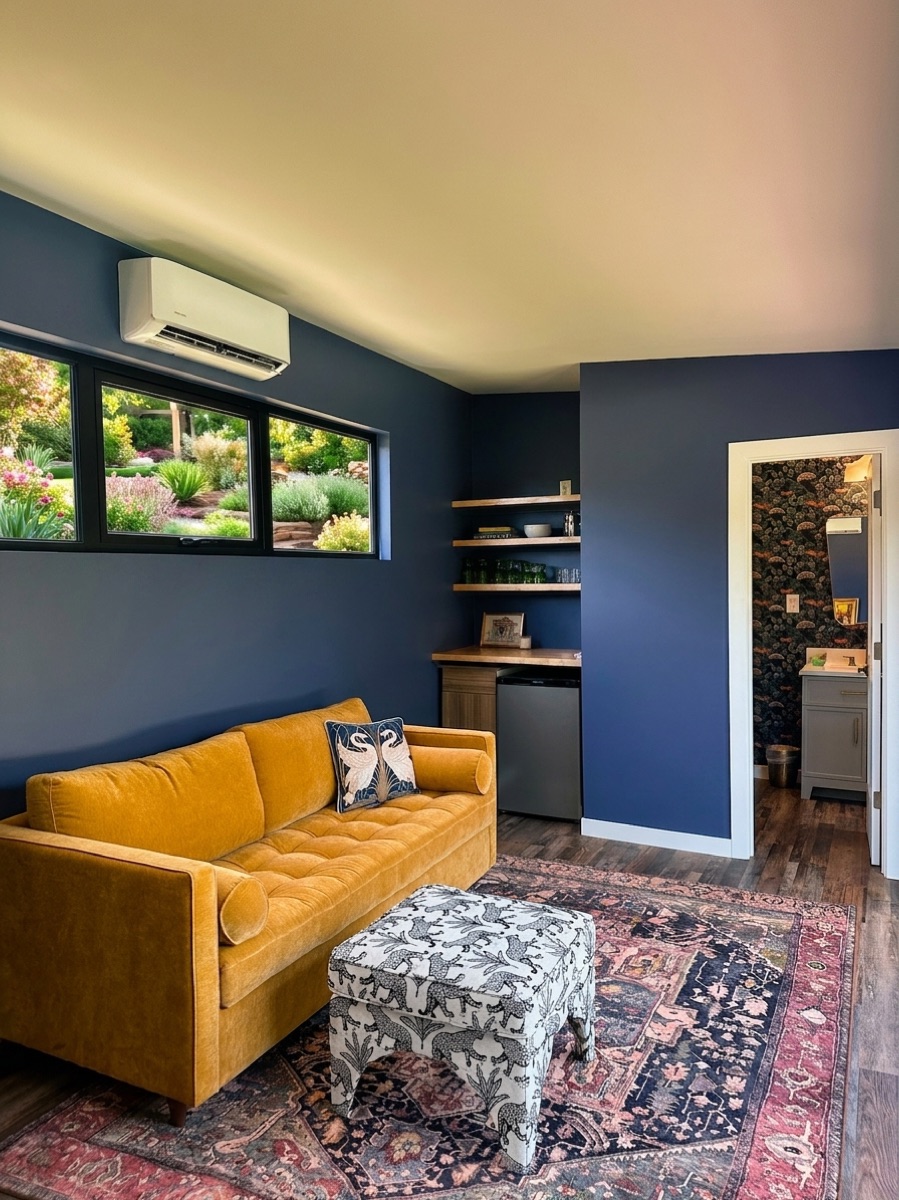
Mini-split heat pumps (ductless systems) are the near-universal choice: they heat and cool efficiently without ductwork, handle Texas's temperature swings, can be controlled from your phone, and run quietly enough for video calls.
| Structure size | Recommended BTU | Notes |
|---|---|---|
| 300–350 sq ft | 8,000 BTU | Efficient cooling for a compact office/studio |
| 350–400 sq ft | 9,000 BTU | Balanced for moderate daily use |
| 400–450 sq ft | 10,000 BTU | Ideal for larger office configurations |
A mini-split running at 90% capacity all day wears out faster and struggles with humidity control. A properly sized unit that cycles correctly lasts longer and stays more comfortable. Professional installation typically runs $1,500–$4,000.

3. Electrical Power: Running a Subpanel
Running power to a detached structure is a permitted electrical project in Austin. From your main panel, a new circuit runs underground to the pod. You have two approaches: run a single 60-amp (or larger) 240V feeder to a small subpanel inside the pod (the right approach for a fully equipped office), or run individual direct circuits from the main panel (simpler and cheaper upfront, but less flexible later).
Minimum recommended circuits
- One 20-amp circuit for general receptacles (electronics, monitors, lighting)
- One dedicated 20-amp circuit for the mini-split (required by code)
- One 20-amp circuit for a kitchenette or second major appliance
- One dedicated circuit for an outdoor GFCI on the deck
Conduit — PVC or rigid metal — is preferable to direct-buried UF-B cable: it lets you upgrade wire later without re-trenching, and the trench is the expensive part. Typical total for a 60–100 ft underground run with permit: $2,000–$5,000. On our pods, the electrical permit and connection are handled for you.
4. Internet: Your Four Options, Ranked
Reliable, fast internet is one of the most under-planned elements of a backyard office. I've talked to homeowners who spent $40,000 on a beautiful space and then ran on spotty Wi-Fi because they didn't think about connectivity until move-in day. Don't be that person.
- Buried Ethernet (best). Run CAT6 through conduit from your router to the pod. $300–$1,500. Full gigabit, zero latency, completely reliable.
- Dedicated outdoor access point (great). Mount a Wi-Fi 6/6E AP on your house aimed at the pod. $150–$400. Near-wired quality within ~75 ft with no major obstructions.
- Powerline adapters (acceptable). Uses your home's wiring to carry signal. $50–$150. Variable — a last resort, not reliable for video calls.
- Starlink or LTE/5G hotspot (niche). When trenching isn't possible and Wi-Fi won't reach. ~$120/month plus equipment.
Running ethernet through a pre-placed conduit costs almost nothing. Digging it up again later costs $500–$1,500. One of the highest-leverage decisions you can make.
5. Soundproofing: Building a Quiet Workspace
A detached structure has a natural advantage — no shared walls. But neighborhood noise (mowers, traffic, dogs) and internal noise (HVAC, fans) can still disrupt calls. The most impactful upgrades, in order of effectiveness:
- Solid-core door. The single biggest upgrade — 10–15 dB quieter than the hollow-core default.
- Acoustic mineral wool (Rockwool). Outperforms fiberglass at the same thickness for sound.
- Mass-loaded vinyl (MLV). Dense material behind drywall on walls facing the noise source.
- Double-pane windows. Standard low-E double-pane dramatically outperforms single-pane; look for high STC ratings.
- Acoustic caulk at all penetrations. Sound travels through tiny gaps more efficiently than through walls. Costs almost nothing.
Flooring, Lighting & Layout: The Details
Flooring: Vinyl plank (LVP) is the practical choice in Texas — it handles humidity swings far better than solid hardwood and comes in convincing wood-look finishes. Avoid solid hardwood and carpet in a detached structure. Lighting: plan for 40–50 foot-candles for focused desk work, include dimmers, and consider warm-to-cool tunable LEDs. Outlets: plan placement before wiring — every 6 ft around the perimeter, with at least one directly behind the desk for clean cable management.
How Backyard Pod Handles This for You
Every Backyard Pod is delivered with these five systems integrated into the design: a properly sized mini-split (in the all-inclusive price), insulated panels engineered for Texas, sliding glass doors with double-pane glass, and electrical connection handled through our permit process. You don't need to spec a mini-split, vet an insulation contractor, or research burial depths — we've done the engineering. What you get is a space that works the day you walk in. You can design yours and see pricing, or browse 400+ finished pods.
The Bottom Line
A great backyard office isn't about looks — it's about function. Insulation keeps climate-control costs manageable. A properly sized mini-split handles Texas summers and winters without drama. A dedicated circuit and buried ethernet give you real infrastructure. Acoustic upgrades make it quiet enough for calls. Get these five systems right, and you've built something you'll actually use every day.
Your home doesn't need more space. It needs better space.
A Backyard Pod gives you the dedicated, climate-controlled, quiet workspace your home was never designed to provide — installed in 4–8 weeks, from $38,990.